Filing your personal tax return in the United States can be confusing, especially if you’re an immigrant, self-employed, or have income from various sources. This guide explains, step by step, how to prepare for tax season, what forms you need, what deductions and credits exist, and when it’s worth working with a professional.
Here you’ll find a clear path to prepare your federal taxes (IRS) and understand how they connect with state taxes, in a simple way without unnecessary technical language.
1. What are personal taxes in the U.S.
Personal taxes in the United States are based on your annual income, your filing status, and the number of dependents you claim.
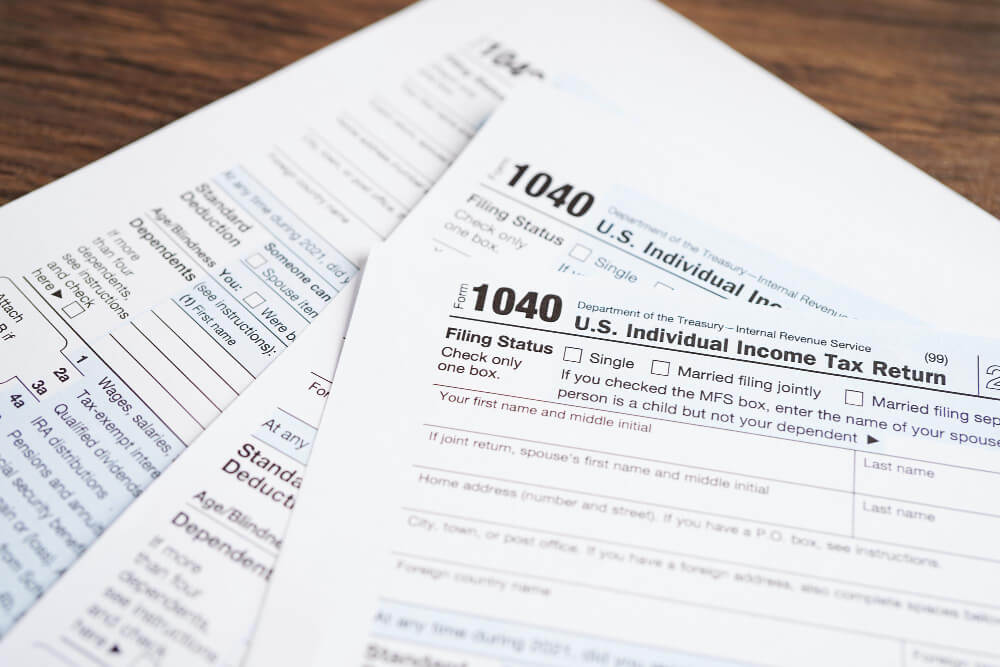
Each year you file a return (generally Form 1040) where you report your income, calculate your tax, subtract credits, and detail what has already been withheld to know if you owe more or will receive a refund.
Tax filing deadlines in the United States
Although the general deadline for the federal return is April 15, there are other important dates that influence when you receive your forms, when you must pay, and how long you have to file if you request an extension. The following table summarizes the key dates you should keep in mind each year.
At CBO Accounting & Advisory Services, we review your situation and provide personalized advice.
Contact Us →| Date | What’s due |
| January 31 | Deadline for employers to send W-2 and 1099 |
| April 15 | Deadline to file federal return and pay owed taxes |
| April 15 | Deadline for state return (in most states) |
| October 15 | Deadline if you requested an extension |
If you can’t file before April 15, you can request an automatic 6-month extension using Form 4868. But the extension is only for filing, not for paying. If you owe money, interest begins to accumulate after April 15.
Federal vs. State Return: How do they differ?
In the United States you normally file two types of returns: the federal return and, in many cases, a state income tax return. The federal return is filed with the IRS and follows the same rules for the entire country. The state return is filed with your state’s tax office and each state has its own rules, rates, and forms.
- The federal always goes to the IRS; the state is sent to your state’s agency (for example, Department of Revenue).
- Some states don’t charge state income tax, so there you only file federal, except for special local taxes.
- You calculate your federal return first and, often, the state uses your federal adjusted income as a base, but applies its own deductions and credits.
- You may receive a different refund amount on the federal and state because they’re calculated separately.
States like Minnesota require, in many cases, an additional state return besides the federal, with their own rules and forms. In contrast, states like Texas and Florida don’t have state income tax, so there you normally only file the federal return (although other state or local taxes may exist).
3. Who is required to file?
Not everyone in the United States has to file a return every year, but many do. The obligation depends on your income level; your immigration status alone doesn’t determine if you must file.
To confirm if you need to file a return this year, you can use the official IRS tool (in English): Check if you need to file a tax return – IRS
In general, you should consider filing a return if:
- Your annual income exceeds the minimum set by the IRS for your filing status (single, married, head of household, etc.).
- Your employer withheld taxes and you want to know if you’re entitled to a refund.
- You had income from self-employment, tips, interest, investments, or cryptocurrencies.
- You received forms like W-2, 1099-NEC, 1099-MISC, 1099-INT, 1099-DIV, or 1099-B.
Even if you earn less than the minimum, many people file a return to claim refundable credits like the Earned Income Tax Credit (EITC) or child credits.
4. Types of Income and Common Forms
The type of income you receive determines what forms you use and how your taxes are calculated.
If you’re an employee (W-2)
When you work for a company as an employee, you receive a W-2 form that shows how much you earned and how much was withheld in federal taxes, Social Security, and Medicare during the year.
Your employer already withheld taxes from each paycheck, so when filing you’re basically calculating if you overpaid (refund) or underpaid (you owe the difference).
Most employees who only have W-2 income can file using Form 1040 without complicated additional forms.
If you’re self-employed (1099)
If you work for yourself, as a freelancer, independent contractor, or on platforms like Uber, DoorDash, or Instacart, you normally receive 1099 forms instead of a W-2.
Difference between W-2 and 1099
| Difference | W-2 (Employee) | 1099 (Independent) |
| Tax withholding | Your employer does it for you | Nobody does it for you |
| Social Security / Medicare | Employer pays half and you the other half | You assume the total self-employment tax (15.3%) |
| Expense deductions | Limited as employee | You can deduct business expenses related to income |
| Additional form | Usually none | Schedule C to report profits and expenses |
If your self-employment income exceeds $400 per year, you must pay self-employment tax in addition to income tax.
Important: since nobody withholds taxes for you, you’ll probably need to make quarterly estimated payments to avoid penalties.
If You Have ITIN Instead of Social Security
If you don’t qualify for a Social Security number, you can obtain an ITIN (Individual Taxpayer Identification Number) to file taxes; the filing process is practically the same in terms of basic forms and steps.
With an ITIN you can:
- File federal and, in many cases, state returns.
- Fulfill your tax obligations.
- Obtain a refund if you’re entitled to one, when your withholdings or credits exceed the calculated tax.
Some tax credits are available for taxpayers with ITIN, but others require a Social Security number, so it’s advisable to review each case on the official IRS page or with a tax professional.
To obtain or renew an ITIN, visit the official IRS page about ITIN.
5. How to prepare before filing (checklist)
Before sitting down with your tax preparer or using software, gather all important information. This way you avoid errors, delays, and smaller refunds than they should be.
Personal documents:
- Social Security Number (SSN) or ITIN for you, your spouse, and your dependents.
- Birth dates of everyone appearing on the return.
- Copy of last year’s return (if available).
Income:
- W-2 forms from each employer.
- 1099 forms (1099-NEC, 1099-MISC, 1099-K, 1099-INT, 1099-DIV, 1099-B).
- Cash or app income (tips, self-employment work, digital platforms).
- Income from property rentals, pensions, or Social Security benefits.
Deductions and credits:
- Receipts for major medical expenses, mortgage interest, local taxes, and charitable donations.
- Childcare or dependent care payments (with provider information).
- Education expenses: 1098-T forms and tuition receipts.
- Proof of child support or alimony payments, if applicable.
Tax payments already made:
- Proof of estimated tax payments made during the year.
- Forms showing federal and state tax withholdings.
5.2 Step by step to prepare your taxes
- Organize your documents by categories (income, expenses, credits).
- Confirm your filing status (single, married filing jointly, head of household, etc.).
- Review whether you’ll use the standard deduction or itemized deductions depending on what’s more convenient.
- Enter the information in reliable software or take it to your preparer.
- Verify that your personal information, Social Security numbers, and bank information are correct to avoid delays in your refund.
- Choose how to file (e-file or paper) and how to receive your refund (direct deposit is fastest).
6. Deductions and Credits You Can Take Advantage Of
Deductions reduce your taxable income. Credits directly reduce the tax you owe. Both help you pay less.
You have two options and must choose the one that benefits you most:
Standard deduction (2025, to file in 2026)
- Single or married filing separately: around $15,750
- Married filing jointly or surviving spouse: around $31,500
- Head of household: around $23,625
Itemized deduction You add up specific expenses like mortgage interest, property taxes, some state and local taxes, charitable donations, and medical expenses exceeding 7.5% of your income.
If your itemized expenses add up to more than the standard deduction, it’s worth itemizing. If not, most people choose the standard deduction because it’s simpler.
To see exact and updated amounts each year, you can review the IRS publication on standard deduction and dependents.
Credits for families
If you have children or dependents, these credits can significantly reduce what you owe or increase your refund.
| Tax credit | Who qualifies? | Approximate amount / benefit |
| Child Tax Credit | Taxpayers with qualifying children who have a valid Social Security number | Up to $2,200 per child for 2025, meeting IRS rules |
| Earned Income Tax Credit (EITC) | Individuals or families with low to moderate income | Can exceed $8,000 in 2025 for families with 3 or more children, depending on income and family situation |
| Child and Dependent Care Credit | People who pay for child or dependent care to be able to work or look for work | Allows claiming a percentage of care expenses, with limits depending on income and tax year |
The EITC is especially important because it’s a refundable credit: if the credit is greater than the tax you owe, you can receive the difference as a refund.
To review requirements and updated amounts, you can do so directly on the official IRS site:
- Child Tax Credit (IRS, to see if you qualify)
- EITC Assistant from IRS (to see if you qualify)
7. Ways to file your taxes
You have several options depending on your situation and preference.
| Option | Approximate cost | Ideal for |
| IRS Free File | Free | People with income (AGI) of $84,000 or less, in different situations |
| Free File Fillable Forms (IRS) | Free | People comfortable filling out forms without step-by-step guidance |
| TurboTax Free Edition | Free (if you qualify) | Simple returns with Form 1040 and W-2, without complex cases |
| H&R Block Free Online | Free (if you qualify) | Simple returns with W-2 and basic credits |
| TurboTax / H&R Block (paid versions) and other commercial software | From $50 to $200+ | More complex situations: self-employment, multiple incomes, advanced deductions |
The IRS Free File program offers free software from recognized brands if you meet the income limit and each provider’s criteria; it’s a little-known option that can save you money if you normally pay for software.
When it’s worth seeking professional help
Doing your taxes yourself works well if your situation is simple. But consider seeking professional help if:
- You have significant self-employment income or own business.
- You have multiple income sources (salary, rentals, investments, etc.).
- You bought or sold properties during the year.
- You received IRS letters or have problems from previous years.
- You don’t understand something and want to make sure you do it right.
- You want strategies to legally pay less taxes.
The cost of a professional preparer varies depending on the complexity of your situation, but the value is in the peace of mind of properly complying with the IRS and not losing deductions or credits due to lack of knowledge. You can consult with an experienced company like Contabilidad BO, which helps you with personal tax preparation, monthly bookkeeping, and accounting for your small business in the United States.
8. How to Track Your Refund
If you’re entitled to a refund, you can track its status from approximately 24 hours after filing electronically using the IRS Where’s My Refund tool.
You’ll need:
- Your Social Security number or ITIN
- Your filing status
- The exact amount of your refund
Refunds sent by direct deposit normally arrive within 21 days if there are no errors or additional reviews; checks by mail can take 6 weeks or more.
If you claimed the Earned Income Tax Credit (EITC) or certain child credits, by law the IRS cannot send your refund before mid-February, so you might see it reflected a little later.
What to do if you owe money
If your return shows you owe money, you have options:
- Pay in full: You can pay online through IRS Direct Pay, with debit/credit card, or by check.
- Payment plan: If you can’t pay everything immediately, you can request a payment plan on the IRS site. There are short-term plans (generally up to 180 days) and long-term plans with monthly payments.
- Don’t ignore the debt: Interest and penalties accumulate while there’s a balance; it’s always better to communicate with the IRS and establish a plan than to let time pass without doing anything.